Readouts written for you
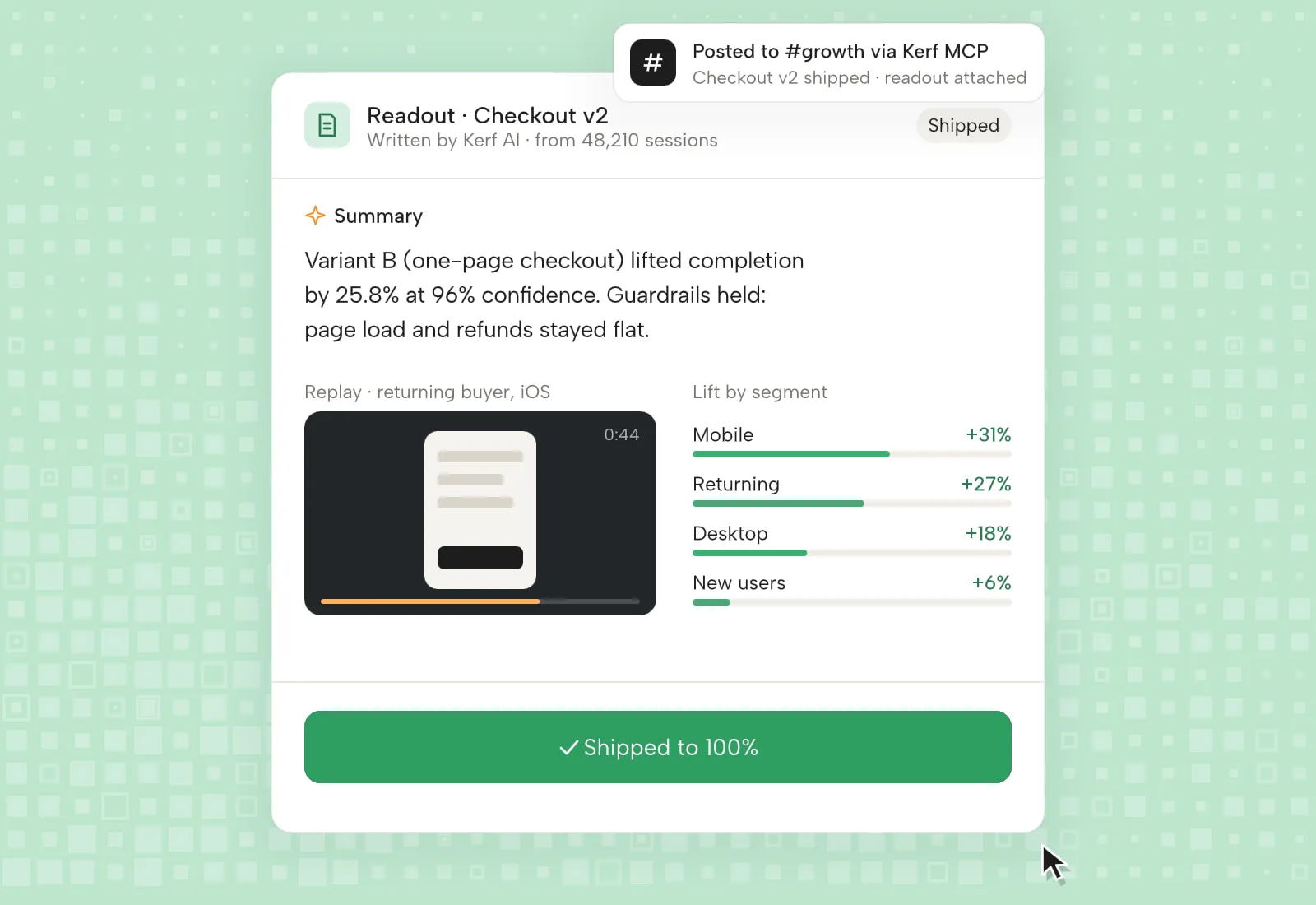
When a test ends, Kerf writes up the result in plain language: the lift, the interval, the guardrails, the segments that behaved differently and a clear recommendation.
What a readout contains
Each readout follows the same structure so a reader never has to hunt. The first line is the decision. The rest is the evidence behind it, ordered by how much it should change your mind.
- Decision: ship, iterate or kill, with the reason
- Primary metric with interval and power
- Guardrails, with any that moved
- Segments where the effect differs
- Replay clips that illustrate the gap
- Suggested follow up test
Grounded, not guessed
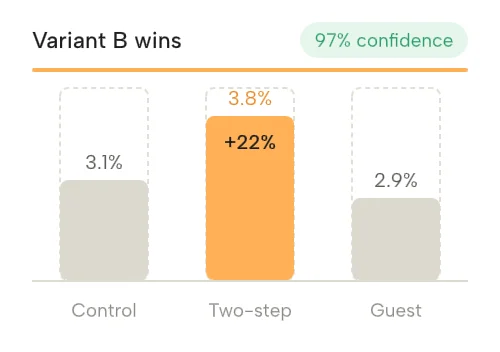
The model never invents numbers. It writes around figures computed by the stats engine and cites each one.
Numbers from the engine
Every figure in the text is linked to the query that produced it. Click any number to see the data.
Checks first
If there is a sample ratio mismatch or a novelty effect, the readout leads with the problem, not the win.
Your language
Set the house style once: how you describe confidence, which metrics matter, what counts as shippable.
Editable
Change anything before you send it. Edits are kept and used as examples for next time.
Where you work
Send to Slack, Notion, Linear or a PDF. Or ask for it in your editor through the Kerf MCP.
Learnings library
Every readout is indexed so you can ask what you already know about pricing before you test it again.

“I used to spend Friday afternoons writing up results. Now I spend ten minutes editing something that is already right.”
In practice
Readout questions
Does my data train a model?
No. Your data is never used to train any model, and readouts run on a zero retention endpoint.
Can I turn it off?
Yes, per workspace or per experiment. The statistics are always available without the written layer.
What if I disagree with the recommendation?
Override it. Kerf records your decision and the reason, which keeps the learnings library honest.