Flags that measure themselves
Put any change behind a flag, target it by plan, region or cohort, and see its impact the moment it goes live. Evaluation happens in your process in under 1 ms.
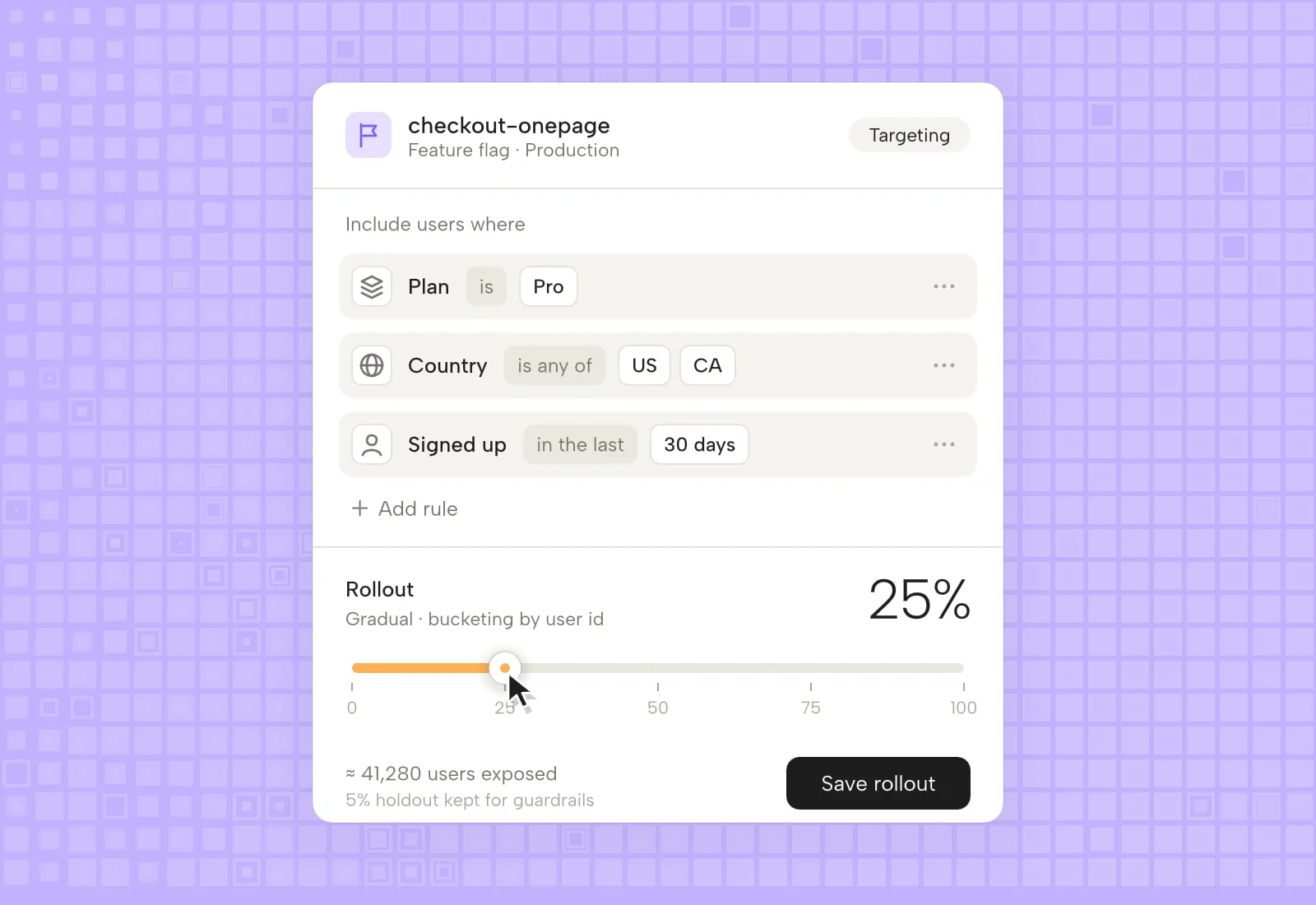
Everything a flag needs
Targeting rules
Match on any user attribute, segment or uploaded list. Rules run top to bottom and the first match wins, so behaviour is easy to predict.
Local evaluation
SDKs download your rules and evaluate them in process. No network call on the hot path, and flags still work if Kerf is unreachable.
Sticky bucketing
A user who sees a variant keeps seeing it, across sessions, devices and SDKs, because assignment is a stable hash of their ID.
Kill switches
Mark a flag as a kill switch and anyone on call can turn it off from the dashboard, the CLI or Slack.
Environments
Separate rules for dev, staging and production, with a diff before you promote anything and a full audit trail afterwards.
Exposure logging
Every evaluation that matters is logged once per user, so a flag becomes an experiment without touching the code.
From flag to experiment in one toggle
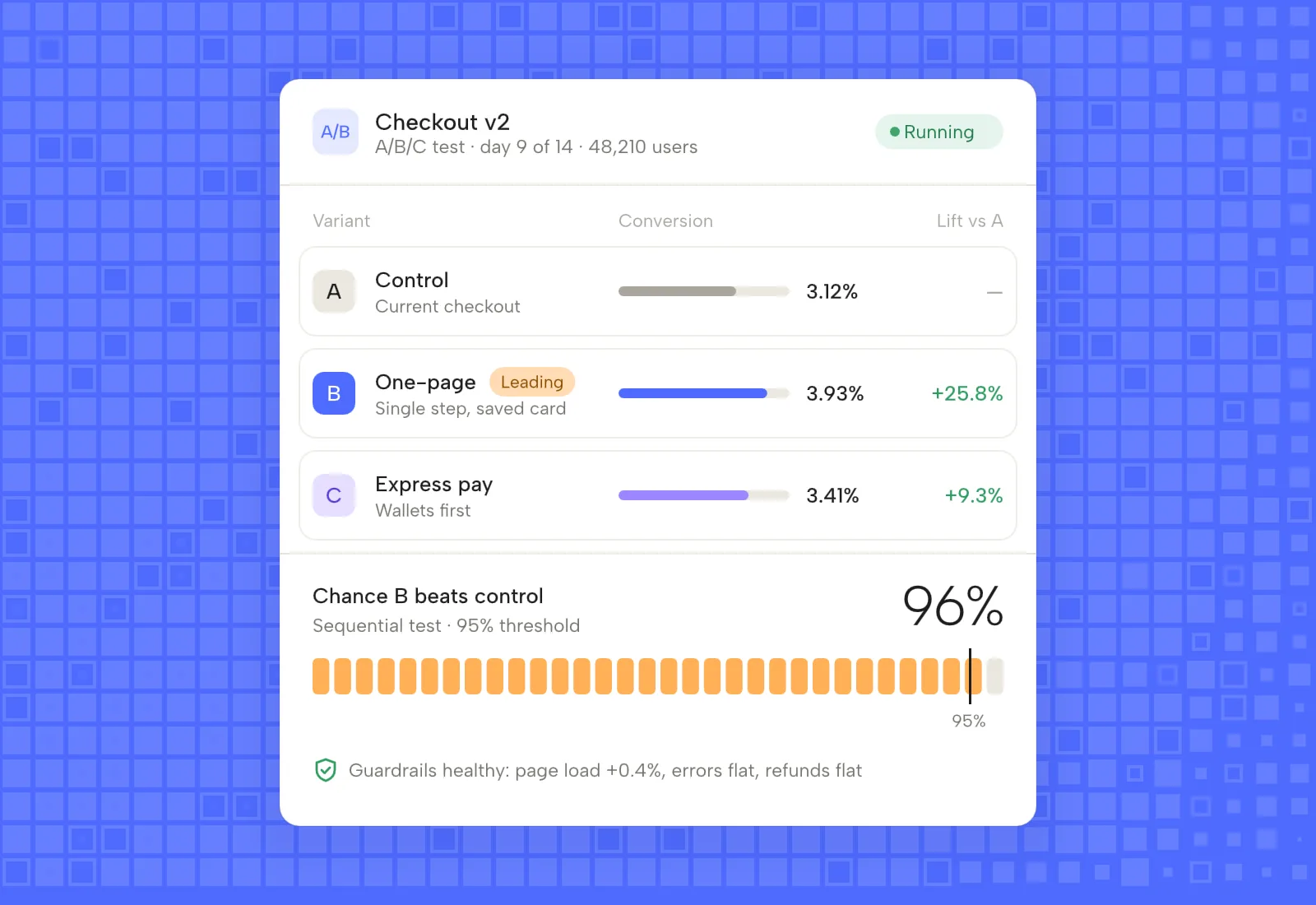
Every flag in Kerf can carry a metric. Turn on measurement and the same bucketing that controls who sees the change also feeds the analysis, so there is no second tool and no mismatch between who was exposed and who was counted.
- Exposure events deduplicated per user
- SRM check runs on every flag with traffic
- Metrics read from your warehouse or Kerf events
Add a flag in four steps
- 01
Create
Name the flag and pick boolean, string, number or JSON. Kerf generates typed accessors for your SDK.
- 02
Target
Add rules for who gets what. Preview any user ID to see exactly which rule matched.
- 03
Ship
Merge your code with the flag off. Turn it on for staff first, then a percentage, then everyone.
- 04
Clean up
Kerf flags stale flags and opens a pull request to remove the dead branch once a flag reaches 100%.

“Flags were the easy sell. What changed the team was that every flag already knew how to become a test.”
Flag questions
Which SDKs do you support?
Server SDKs for Node, Python, Go, Java, Ruby and .NET, client SDKs for web, iOS, Android and React Native, and an edge SDK for Workers and Vercel.
What happens if Kerf goes down?
SDKs keep serving the last known ruleset from memory and from an optional local file. Evaluation never blocks a request.
Can I control flags from code review?
Yes. Flag definitions can live in a file in your repo and sync through the CLI, so changes get reviewed like any other change.
How do you avoid flag sprawl?
Every flag has an owner and an expiry. Stale flags show up in a weekly digest, and we open the removal pull request for you.